PANECO – Product Development Story
A story of products shaped from “PANECO,” a material transformed from clothing.
Fashion Loss
There is a term called “fashion loss.”
It has become a global issue, but here we will look at the situation in Japan.
Clothing production places a significant burden on the environment. During the manufacturing process, large amounts of CO₂ are emitted, and vast quantities of water are used. Since 98% of the clothing sold in Japan is imported from overseas, energy is also required for transportation.
In Japan, people purchase many clothes and then discard them. On average, it is said that each person owns about 25 items of clothing that are never worn even once in a year.
Of the clothes that are discarded, 32% are given away, reused, or recycled, while the remaining 68% are thrown away as garbage. Of that waste, only 5% is recycled into resources, while 95% is either landfilled or incinerated.
This amounts to 1,300 tons per day nationwide—the equivalent of 130 large trucks. Annually, this reaches 470,000 tons.
In addition, within the fashion industry, there is the reality that unsold items are inevitably discarded and incinerated in order to maintain brand value. So how much is actually disposed of?
It is said that 13% of domestic apparel remains unsold. Of this, excluding items that are resold in the following season or sold through outlets, 0.3% is disposed of. This may seem small at first glance, but out of the total supply of 820,000 tons in 2020, 2,460 tons of brand-new clothing were discarded.
In Japan today, 820,000 tons of clothing are supplied annually, and 520,000 tons are discarded. Clothing that requires enormous energy to produce is ultimately disposed of using even more energy.
The definition of “fashion loss” varies, but in response to this situation, various initiatives have begun.
In January 2023, France enacted a law prohibiting companies from discarding unsold new clothing.
Reference: Ministry of the Environment Japan / Japan Research Institute, 2021, “Fashion and the Environment”
Encounter with Paneco
There is a person who took unique action against this issue of “fashion loss.”
He is Mr. Kazuhiro Hara of Work Studio, a company engaged in the design, manufacture, and sale of fixtures. He visited us suddenly in the spring of 2020.
A great lover of fashion, Mr. Hara was passionate about turning unsold, discarded clothing into interior panels. Determined to address this issue, he repeatedly experimented through trial and error.
Early samples were not made solely from textile fibers; they included mixtures of paper, wood powder or chips, and even carbon. The texture was somewhat rough. While it seemed further refinement was needed, we sensed potential in the concept and decided to collaborate.
Later, with the cooperation of the textile trading company Moririn, Paneco was finally completed.
The first Paneco we saw had tightly bound fibers, forming a solid board—it had become a highly appealing material. The journey to this point must have involved tremendous effort.
The product has a thickness of 5.5 mm and dimensions of 920 mm × 920 mm, with physical properties comparable to wood particle board.
Paneco Recycling System
Work Studio has established a recycling system for Paneco.
First, clothing is collected from society. Then, at welfare facilities, zippers, buttons, and other metal parts are removed. This process also creates employment opportunities for these facilities.
The stripped garments are shredded into fibers, processed, and turned into panels—becoming Paneco.
Furniture and spaces using Paneco are then introduced into society. After a period of use, when Paneco is no longer needed, it can be collected, shredded again, and returned to Paneco once more.
This is a crucial point: it is rare to encounter materials with an established re-recycling system.
Upcycled materials are integrated into a circular recycling system—Paneco is built upon such an attractive system.
The Expression of Paneco
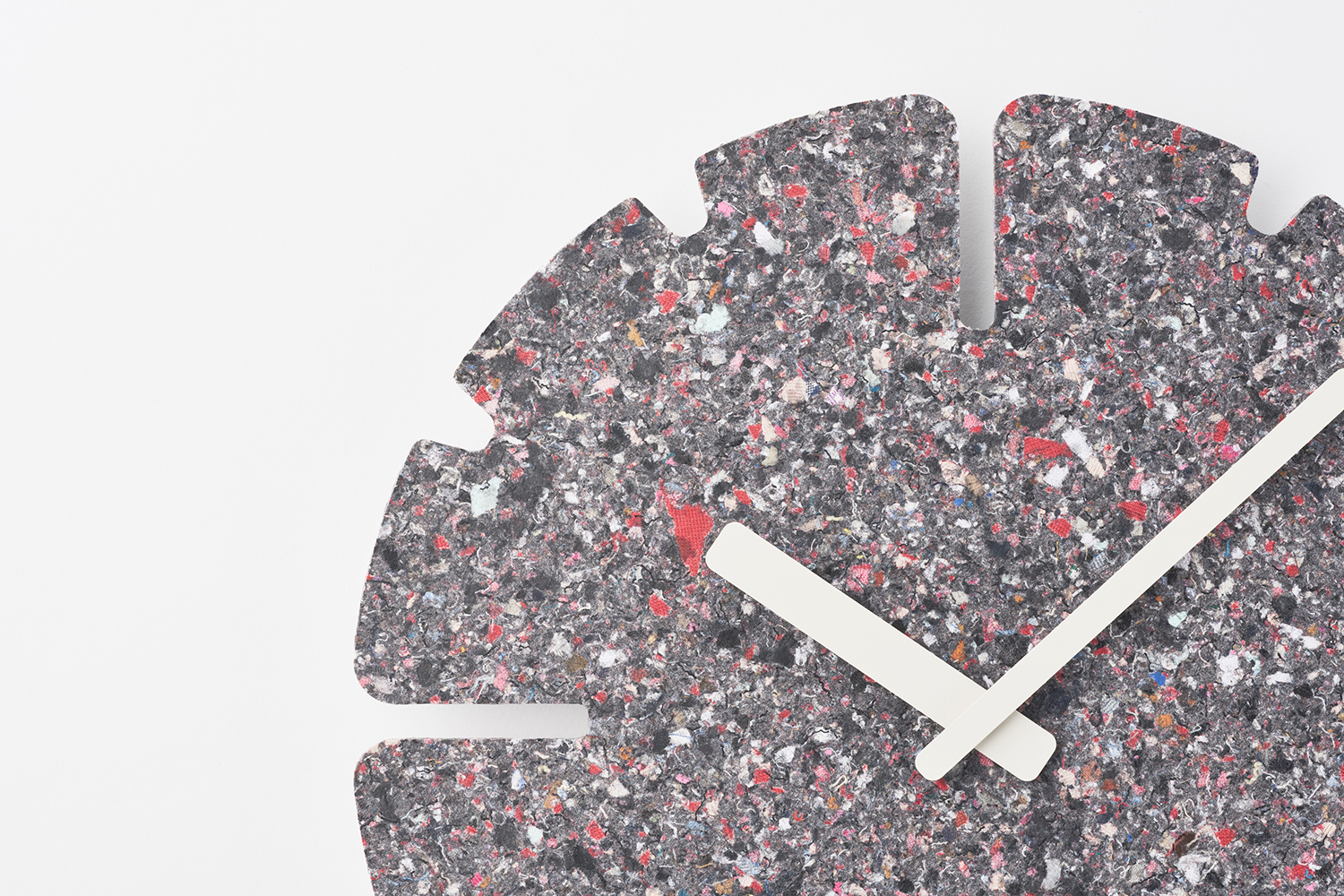
Paneco changes its appearance depending on the types of clothing available at the time. Usually, the colors mix and result in gray—just like mixing various paints produces gray.
However, occasionally the shredded fibers are larger, allowing the texture of the fibers to be visible. Upon closer inspection, one might find glitter embedded within, or a deep blue tone suggesting denim fabric.
Very rarely, since paper tags are also shredded, traces of printed tags can appear within the material.
Paneco captures a moment in time like a fossil, revealing a variety of expressions. Currently, two types are available based on the size of the shredded fibers: Sand and Stone.
To the First Paneco Exhibition
The first Paneco exhibition was held in Moririn’s exhibition space. Using Paneco made from recycled clothing, furniture designed for long-term use was created.
In particular, a modular bookshelf that can be reconfigured after moving proved highly practical and long-lasting. When it is eventually discarded, it can be returned to Paneco again.
This initiative aims to further reduce environmental impact by extending the lifespan of Paneco products within the recycling loop.
Work Studio used a large Thomson press to produce this furniture. It was surprising that such large pieces could be cut with a Thomson press. While they mentioned that the process was not easy, they successfully created impressive large-scale furniture.
To the Sustainable Fashion Expo
In the autumn of 2020, Paneco was exhibited at the Sustainable Fashion Expo.
The concept was “a space made with Paneco.” Shelving units were used as partition walls to create a room-like space. The exhibition expressed the desire for Paneco to be used in spatial design.
It attracted many visitors and received high praise. Prototypes of several furniture pieces, including tables and pet houses, were also created.
Additionally, a prototype of what would later become the Paneco Clock—cut using a Thomson die—was produced. The cleanly cut numbers demonstrated strong potential.
2021 Milan Design Week
In June 2021, while the impact of COVID-19 was still significant, Paneco was exhibited at Milan Design Week.
Development continued, and following the 5.5 mm version, a 3 mm Paneco was introduced. This thinner version is flexible and can be bent, enabling proposals for spaces incorporating curved forms.
Prototypes of the Paneco Clock and a bentwood chair by Akita Mokko with a Paneco seat were also exhibited, receiving positive responses.
Various experiments were conducted, including chairs, sofas, and bookshelves that showed strong potential for practical application.
The Birth of the Paneco Clock
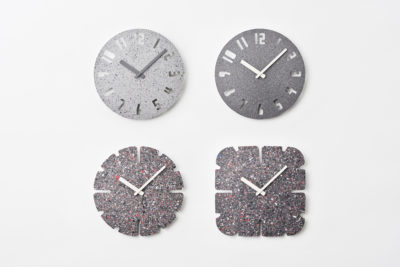
After several prototypes, the Paneco Clock was finally completed.
Recycled clothing marking the passage of time—this resulted in a truly pleasing product.
Each Paneco piece has a unique expression, quietly accompanying people in their daily lives.
Encounter with Ai Tominaga
Meeting Ai Tominaga became a major turning point for us.
She practices an ethical and sustainable lifestyle and supported our proposal. When we were commissioned to select furniture for her new studio, we collaborated with her to design a Paneco bookshelf.
This became the first Paneco furniture piece installed in an actual living environment. She was captivated by Paneco’s unique texture and expression, and expressed great appreciation.
Later, during the renovation of her home, we also designed a Paneco bookshelf and a center table. Having someone with strong influence like her support our work has been incredibly encouraging for us.
In modern society, environmental issues have become a serious challenge. We may not be able to find all the answers in our generation regarding how humanity should live. However, we believe we have a responsibility to pass the baton to the next generation.
In this context, Paneco appears to be a meaningful solution. As designers, by using materials like Paneco, we can contribute to addressing environmental issues. Through design, we can also raise awareness about these challenges.
We will continue to explore what we can do and what we can communicate, while advancing our efforts toward environmental sustainability.